- Login to the backup application's user interface.
- For backup client computer on Windows, double-click on the OBM desktop icon or right-click on the system tray icon:
- For backup client computer on Mac OS X, double-click on the OBM desktop icon.
- For VMware Server installation on Linux, enter the following command to start the OBM graphical user interface:
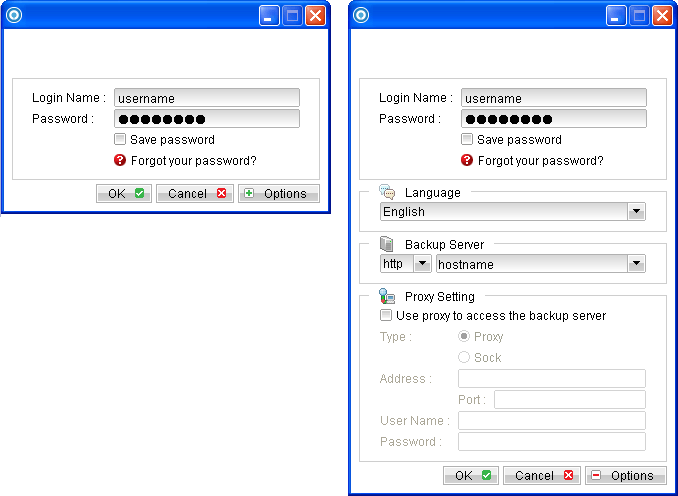
# sh /usr/local/obm/bin/RunOBC.sh &
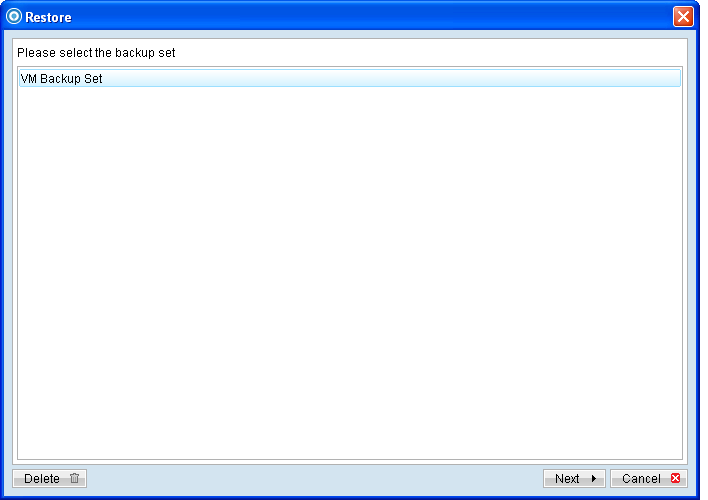

User will be prompted if a virtual machine selected to be restored exist on the hypervisor.

For original virtual machine with no snapshot
- Open VMware vSphere Client.
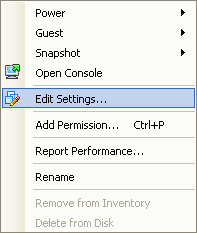
Under inventory, right click on the newly restored virtual machine, select [Edit Settings].
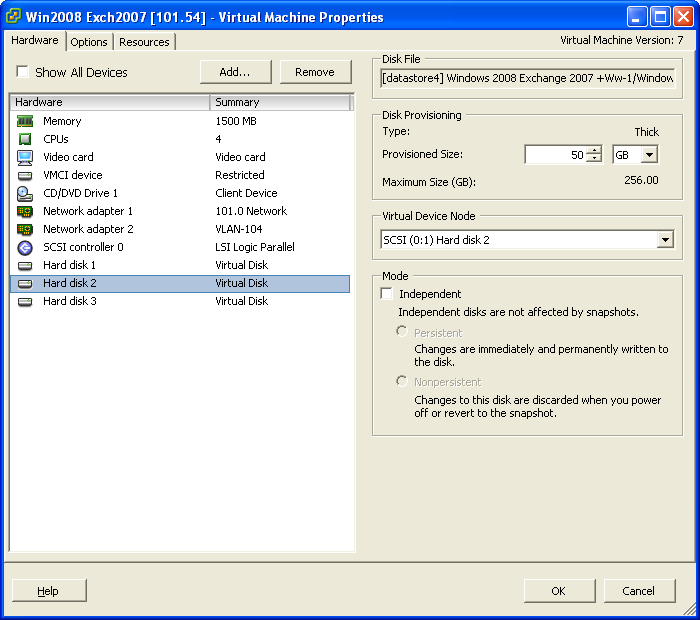
For each virtual disk that was not restored, remove the corresponding [Hard disk] from [Hardware].
- Start the virtual machine afterward.
For original virtual machine with snapshot (non-VDDK mode)
- Open VMware vSphere Client.
Under inventory, right click on the newly restored virtual machine, select [Edit Settings].
For each virtual disk that was not restored, remove the corresponding [Hard disk] from [Hardware].
- Remove the VM from inventory.
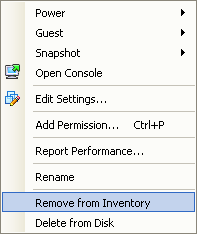
Right click on the newly restored virtual machine; select [Remove from Inventory].
- Locate the virtual machine's folder location on the hypervisor.
- Delete the lines of the removed virtual disk.
- Open the corresponding ${VM-Name}.vmsd file at the following location with a text editor.
Important
Serious problem may occur if the configuration files are incorrectly modified; it may prevent the virtual machine from starting.
Please only perform the following procedures if you have in-depth knowledge on VMware product.
${VM-Location}\${VM-Name}.vmsd
Example:
Snapshot 1, SCSI (0:2) Disk 2 is removed.
.encoding = "UTF-8"
snapshot.lastUID = "1"
snapshot.numSnapshots = "1"
snapshot.current = "1"
snapshot0.uid = "1"
snapshot0.filename = "Windows 2008 Snapshot1.vmsn"
snapshot0.displayName = "Snapshot1"
snapshot0.description = ""
snapshot0.createTimeHigh = "309233"
snapshot0.createTimeLow = "1291281261"
snapshot0.numDisks = "3"
snapshot0.disk0.fileName = "Windows 2008-1.vmdk"
snapshot0.disk0.node = "scsi0:0"
snapshot0.disk1.fileName = "Windows 2008-1.vmdk"
snapshot0.disk1.node = "scsi0:1"
snapshot0.disk2.fileName = "Windows 2008-2.vmdk"
snapshot0.disk2.node = "scsi0:2"
.encoding = "UTF-8"
snapshot.lastUID = "1"
snapshot.numSnapshots = "1"
snapshot.current = "1"
snapshot0.uid = "1"
snapshot0.filename = "Windows 2008 Snapshot1.vmsn"
snapshot0.displayName = "Snapshot1"
snapshot0.description = ""
snapshot0.createTimeHigh = "309233"
snapshot0.createTimeLow = "1291281261"
snapshot0.numDisks = "3"
snapshot0.disk0.fileName = "Windows 2008-1.vmdk"
snapshot0.disk0.node = "scsi0:0"
snapshot0.disk1.fileName = "Windows 2008-1.vmdk"
snapshot0.disk1.node = "scsi0:1"
Update the number of virtual disk.
- Open the corresponding ${VM-Name}.vmsd file at the following location with a text editor.
${VM-Location}\${VM-Name}.vmsd
Example:
Snapshot 1, if one of the disks is removed, updates the value of snapshot0.numDisks
.encoding = "UTF-8"
snapshot.lastUID = "1"
snapshot.numSnapshots = "1"
snapshot.current = "1"
snapshot0.uid = "1"
snapshot0.filename = "Windows 2008 Snapshot1.vmsn"
snapshot0.displayName = "Snapshot1"
snapshot0.description = ""
snapshot0.createTimeHigh = "309233"
snapshot0.createTimeLow = "1291281261"
snapshot0.numDisks = "3"
snapshot0.disk0.fileName = "Windows 2008-1.vmdk"
snapshot0.disk0.node = "scsi0:0"
snapshot0.disk1.fileName = "Windows 2008-1.vmdk"
snapshot0.disk1.node = "scsi0:1"
snapshot0.numDisks = "3"
To
snapshot0.numDisks = "2"
.encoding = "UTF-8"
snapshot.lastUID = "1"
snapshot.numSnapshots = "1"
snapshot.current = "1"
snapshot0.uid = "1"
snapshot0.filename = "Windows 2008 Snapshot1.vmsn"
snapshot0.displayName = "Snapshot1"
snapshot0.description = ""
snapshot0.createTimeHigh = "309233"
snapshot0.createTimeLow = "1291281261"
snapshot0.numDisks = "2"
snapshot0.disk0.fileName = "Windows 2008-1.vmdk"
snapshot0.disk0.node = "scsi0:0"
snapshot0.disk1.fileName = "Windows 2008-1.vmdk"
snapshot0.disk1.node = "scsi0:1"
Important:
The restored virtual machine does not support the reversion of previous snapshots if they contain virtual disks not restored.